
Enable vs. Support
By Sandy Krause February 16, 2024
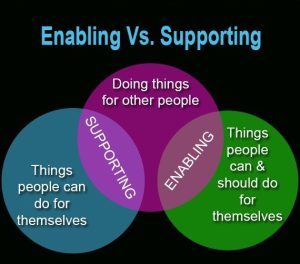
In psychotherapy and mental health, enabling is a term that means giving a positive sense of empowering individuals or a negative sense of encouraging dysfunctional behavior. Most parents use the words empower or support instead of ‘enable’ for the positive type of enabling.
Parenting is a balancing act in so many ways. Every decision has layers, levels, and subtle details to consider. As the mom of young adults, I see how important these parenting choices become as they make their way in the world. We do what we think is best at the time, but sometimes, there are unintended results. One of the biggest factors in their healthy independence is enabling vs supporting.
It’s those encouraging words we use to help our kids own their choices. We empower them to have their own free choices and to learn the consequences of those choices. We support them in how to handle things that don’t work out well.
Sometimes, it feels like a thin line between enabling and supporting. We all need help at times. Helping becomes enabling when it’s a constant pattern. Listening to someone working through their decision and guiding them with wisdom is empowering. We have these same balancing issues with siblings, family, and friends.
When the support provided becomes necessary for the person’s survival, and the person isn’t trying to handle things themselves, it’s crossing into the enable zone. Remember, as parents, we won’t be there for our kids their whole lives; we will, at some point, be gone. The goal is to empower them to launch beyond us, to fire ourselves from our early parenting role.
If we encourage dependence or dysfunctional behavior, there are dire consequences. Not letting the lesson of natural consequences teach kids and adults sets them on a troubling path. Parents are wired to protect their kids. But sometimes, they need to feel the hurt of what they’ve brought upon themselves.
There is a young woman I’ve known for many years. She’s had some challenges beyond being autistic. There is a pattern of risky behaviors. She gets herself into trouble. Whenever she gets into a situation, her dad swoops in and cleans up her mess. He hides what she’s done from others in her life, including the professionals who are trying to help her. She and her father both put up a fake all-is-perfect front. This pattern was in place during her most crucial developmental years.
This woman has never suffered the consequences of her own actions. She gets into trouble, and it’s cleaned up and swept away. The work to clean up the mess is not done by her. She messes up relationships, and the other person is blamed. The path of destruction is left behind; her dad has cleared the way for her to move forward and never look back.
Now she’s 21, getting into even more trouble. The kind of trouble that can’t be easily swept into hiding. The type of trouble that messes up your life. It’s beyond what Dad can fix now. And she is stunned. She’s had a mirror shoved at her for the first time, forcing her to see the mess she created; it’s painful. She’s had her life affected by what she’s done. She has no experience taking responsibility, so she’s not handling the pressure well.
These are the things that spin in my mom head. We all second-guess ourselves. But that balance between helping our kids and letting them figure it out is a constant internal debate. There are times I realize I’ve helped too much, and it’s entered into the enable zone. There are times I know I should have done more to help. But with each decision, I was doing what seemed best at the time, out of love. Each is a piece of the goal moved my kids towards being just fine when I’m gone.
That is, after all, my job. To make myself not needed.
Where to Find Us
You can find us on Facebook and meetup. If you have any questions or concerns, click the email link below or send questions to wisconsinautism@gmail.com
Newsletter
Subscribe to our email to get updates.
 Wisconsin Autism Empowerment